You got the letter. Now what?
Starting in 2027, New York is rolling out work requirements for Medicaid. If you are between 19 and 64 and in the MAGI expansion group, you must meet the monthly requirement through 80 hours of qualifying activity, school at least half-time, or the monthly MAGI-based household-income threshold — unless exempt. The rules are scattered across NY State of Health notices, local department of social services letters, and dense regulatory language. Miss one deadline, and your coverage is on the line.
The New York Medicaid Work Requirement Compliance System puts every rule, exemption, deadline and reporting step in one place, in plain language, so you can keep your coverage without hiring a lawyer or spending hours on hold with the state.
What makes this different from free information
The rules exist on government websites. Nobody is hiding them. But they are written for policy analysts, broken across dozens of pages, and the pieces do not tell you what to do next. NY State of Health publishes implementation details but does not walk you through which forms to file for your situation. Local departments of social services answer the phone — eventually — but documented hold times run into hours, and the person who picks up cannot sit with you through every exemption category, every document format, and every deadline.
This guide takes every piece of that — the federal law under H.R. 1, the CMS implementation rules, New York's verification procedures, and the OTDA fair hearing process — and turns it into a step-by-step system you can follow on your own schedule.
What's inside
- Applicability worksheet — find out in a few minutes whether you may be subject to the 80-hour rule, based on your age, Medicaid eligibility group, Medicare status, and pregnancy/postpartum status
- 80-hour activity tracker — one monthly log for five activity categories, with space to record hours, income, expenses, and proof
- The $580 income shortcut explained — if your monthly MAGI-based household income meets the federal threshold, you satisfy the rule without tracking individual hours; the guide explains how the state checks wages and what manual proof you need when those checks do not verify your income
- Complete exemption guide with proof checklists — every statutory exemption (parenting a child under 14, medical frailty including disabling mental health conditions and substance use disorder, family caregiving for a disabled individual, pregnancy, participation in a drug or alcohol treatment program, and more), what proof each one requires, and how to report it so the exemption holds at renewal
- State verification decoder — how NY State of Health's Truv payroll-data option can help verify work activity, and what manual documentation you need when an automated check does not verify your activity
- 30-day notice response plan — what a notice of non-compliance actually says, the deadlines buried in it, and a step-by-step procedure for assembling your response before the window closes
- Fair hearing and Aid Continuing guide — how to request a State Fair Hearing through OTDA, the difference between the 10-day Aid Continuing deadline and the full hearing request window, and how to keep your coverage active while the decision is reviewed
- Free help directory — verified contact details for NY State of Health (1-855-355-5777), Community Health Advocates (1-888-614-5400), The Legal Aid Society (NYC, 1-888-663-6880), NYLAG, Empire Justice Center, and NYSOH-certified navigators
Who this is for
- Adults on Medicaid who need to meet the 80-hour rule — whether you work a regular job, drive for a rideshare app, do seasonal work, or piece together multiple part-time gigs
- Family members handling the paperwork — if you are helping a parent, adult child, or partner navigate the work requirement, the guide gives you the same system the enrolled person needs, in language that makes it easy to manage on their behalf
- People who think they might be exempt — the exemption screening checklist tells you which category fits, what proof to gather, and how to report it so the exemption holds at your next renewal
- Anyone who already got a notice — the 30-day response plan and the fair hearing chapter are designed for people on a deadline
Why not just call the state?
You should call the state — and the guide tells you exactly when and why. But NY State of Health and local departments of social services handle millions of Medicaid members. Hold times are long, and documented experiences from enrollees include multi-hour waits, lost paperwork, and scanner receipt errors at local offices. The person who answers can process your paperwork, but they cannot sit with you for an hour and walk through every exemption category, every document format, and every deadline. The guide is the preparation you do before that call, so the call itself takes five minutes instead of five attempts.
Important: this is not a government guide
This guide is published by Coverage Start Guide, an independent publisher. It is not affiliated with NYSDOH, NY State of Health, NYC HRA, CMS, or any government agency. It does not provide legal advice and it does not guarantee eligibility, exemptions, or hearing outcomes. The state Medicaid agency, legal aid, and navigators help for free — the guide lists every one of them and tells you when to call.
If your coverage is about to end in fewer than 10 days, skip this page and call the OTDA Office of Administrative Hearings at 1-800-342-3334 or Community Health Advocates at 1-888-614-5400. They help for free and they can act faster than any guide.
What you get
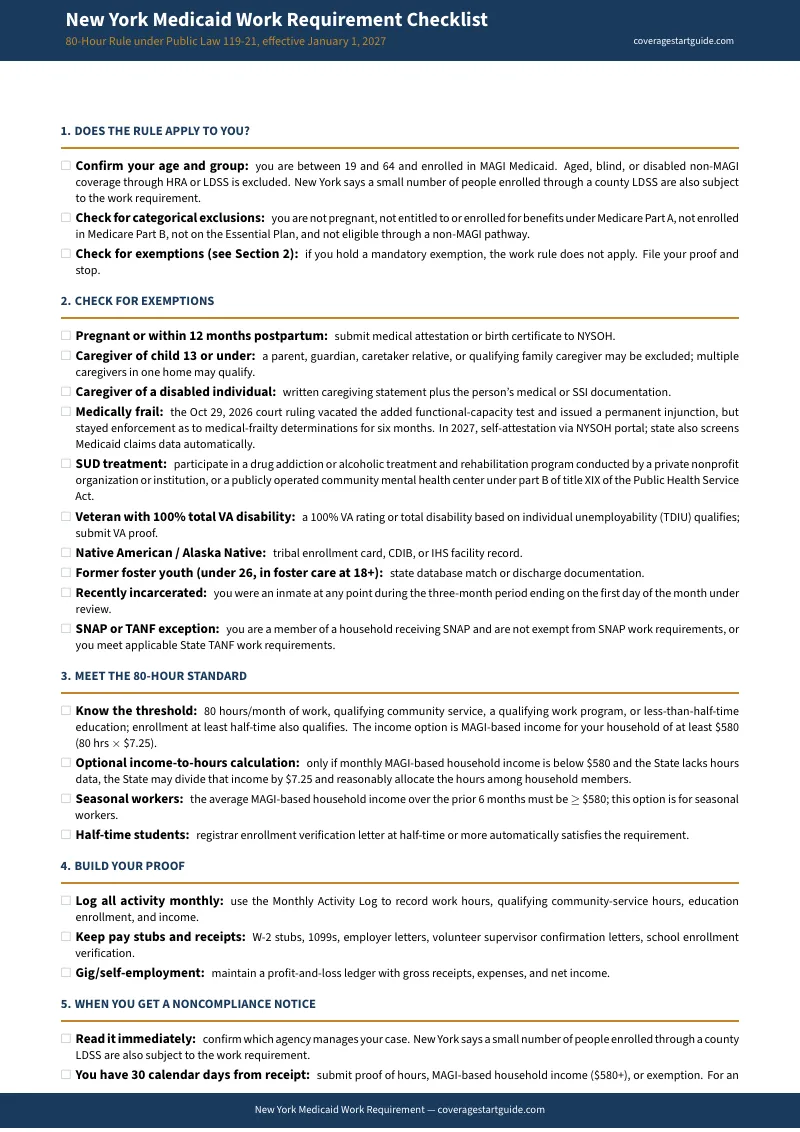
Your download includes 7 PDFs: the full guide (54 pages, readable on any device or printable), five standalone printable worksheets — the applicability screener, monthly activity tracker, exemption documentation checklist, notice response worksheet, and agency communication log — and a two-page quick-reference checklist. The guide is dated and reflects the latest federal and New York State implementation guidance available at the time of publication. Full refund, no time limit — email [email protected] and we will process it.
The free checklist covers the basics: the applicability questions, the core exemptions, the key dates, and the free-help contacts. The full guide adds the how — chapter-by-chapter instructions, standalone worksheets you can print and bring to appointments, and the complete exemption proof requirements.
Get the New York Medicaid Work Requirement Guide →
Frequently Asked Questions
What if the rules change after I buy?
We update the guide when the rules change. Email us any time, even years later, and we'll send you the current edition free.