You got the letter. Now what?
Your state says you need to meet the Medicaid community-engagement requirement for one or more months to keep coverage. For a month, you can meet it with at least 80 hours of qualifying work, community service, or work-program activity; qualifying education at least half-time; a combination of qualifying activities totaling 80 hours; or the required earnings threshold. But the law also created exemption categories — if you know which one fits you and what proof your state actually needs.
That is the problem. The exemptions exist, but the system does not hand them to you. State portals have check-boxes with no explanation. Agency notices use dense statutory language. And the free resources that explain the rules — policy briefs, legal aid fact sheets, CMS guidance — read like they were written for other policy analysts, not for someone staring at a noncompliance notice wondering whether their coverage ends next month.
The Exemption Proof System
This guide takes every exemption the federal law created and turns it into something you can act on: which category fits your situation, what documentation your state may ask for, whether the state is supposed to find the proof from its own records, how often you have to show it again, and what to do when the state says no.
It is built around one principle: your state Medicaid agency decides whether you are exempt, but you decide how organized the evidence is when it lands on their desk.
What is inside
- Every exemption category, explained in plain language — medically frail (all five statutory subcategories), pregnancy and postpartum, parent or caretaker of a child under 14, caregiver of a person with a disability, veterans with a total disability rating, qualifying substance use treatment, American Indian and Alaska Native, former foster youth under 26 who meet the foster-care and Medicaid history criteria, and people meeting the TANF work test or certain SNAP household tests. The guide also explains how people who were inmates at any point in the three-month period before a month are deemed to meet the requirement for that month. Each exemption gets its own section: who qualifies, what proof is needed, and how long it lasts.
- The medical frailty chapter your doctor needs to read — the five categories that qualify as "medically frail," how the October 2026 court ruling changed the standard, what a treating physician's attestation can say about which statutory category applies, and why a diagnosis alone may not provide enough information to verify it.
- A dated state implementation table — selected states' enforcement status, portals, and lead agencies, from early starters to states preparing for the federal deadline. Because "January 2027" does not mean the same thing in Nebraska (which started May 2026) as it does in a state that has not announced a date.
- How states use available information to verify exemptions — federal law requires states to use reliable information already available to them, where possible, before asking for more documentation. Nebraska reviews 12 months of claims data approximately 90 days before your eligibility period ends. Understanding this process means you can check whether your records will speak for you, or whether you need to file documentation yourself.
- What to do when the state says no — how to request an administrative fair hearing within the deadline, how to organize your evidence, what the hearing process looks like, and when to contact legal aid. The guide does not provide legal representation, but it explains the procedural mechanics so you are not starting from zero.
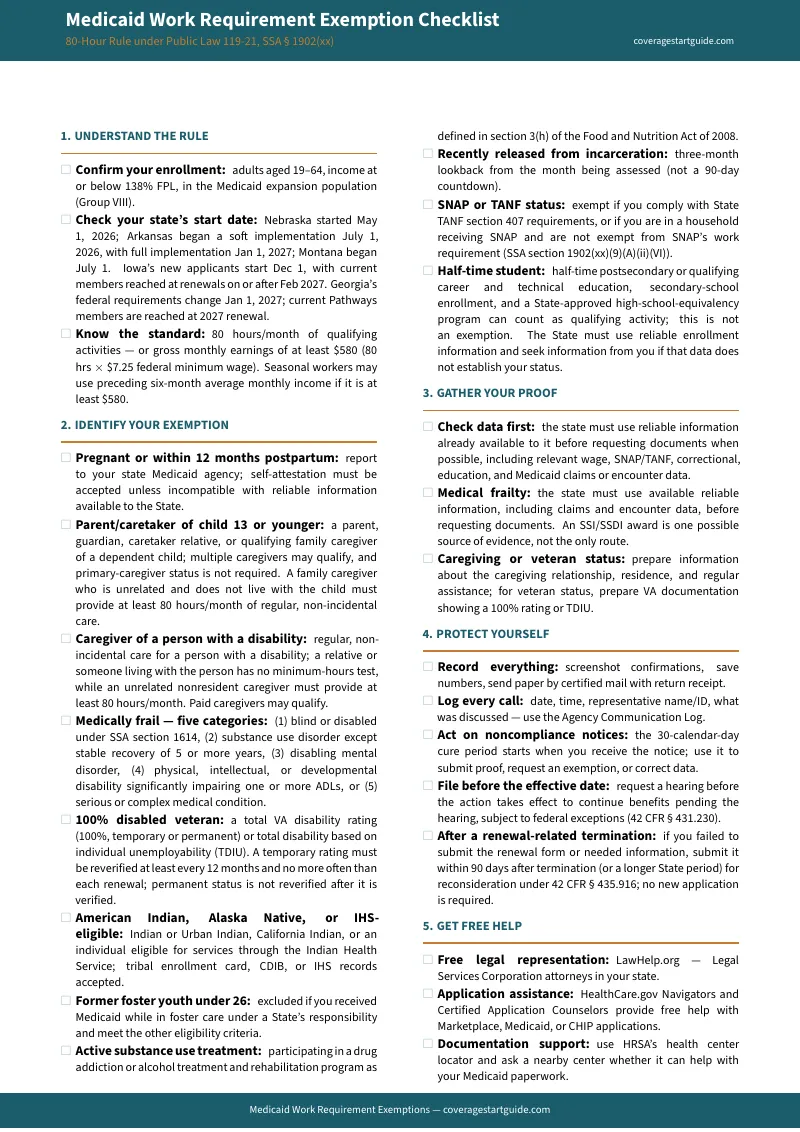
- A printable exemption checklist — a one-page overview of every category and the proof to gather for each, included free for anyone who wants to start organizing before deciding on the full guide.
- 5 standalone worksheets you can print and fill in — an exemption category identifier to find which categories fit, a medical frailty documentation prep sheet for your doctor visit, an agency communication log for every call and submission, a notice and deadline tracker for calculating your response dates, and a fair hearing preparation checklist for building your evidence packet.
Who this is for
- Adults aged 19 to 64 on expansion Medicaid who have a health condition, care for a young child or a disabled relative, are pregnant, are a student, a veteran, in treatment, or recently released — and need to understand whether the 80-hour rule applies to them
- Family members helping someone navigate the exemption process — adult children, spouses, siblings who handle the paperwork
- Anyone who received a state notice about work requirements and wants to understand their options before a deadline arrives
Who this is NOT for
- If you have an active appeal deadline in five days or less — do not buy this guide. Contact legal aid immediately through LawHelp.org. You need a lawyer, not a guide.
- If you are in a medical crisis or hospitalized — ask your hospital's financial counselor whether they can help with Medicaid paperwork or hospital presumptive eligibility. Each hospital decides whether to make presumptive-eligibility determinations.
- Anyone looking for SNAP (food stamps) work rules, Medicare enrollment, or long-term care planning — this guide covers only the Medicaid expansion work requirement.
Why not just use free resources?
You should use free resources. Your state Medicaid agency, legal aid, and HealthCare.gov navigators help for free, and this guide tells you how to reach each one. But here is what free resources do not do well:
- State portals take your documentation — they do not tell you what clinical wording satisfies their reviewers or what happens when their automated data check misses your records.
- Legal aid provides representation in hearings, but capacity is severely limited. Most offices prioritize emergency litigation and cannot help with routine paperwork organization.
- Navigators can help with Marketplace applications and eligibility appeals, but cannot provide legal advice. For a Medicaid fair hearing, contact legal aid.
- Policy briefs from organizations like KFF and Georgetown explain the rules at a macro level, but they do not give you a list of the documents to put in your folder or tell you how Nebraska's 90-day claims lookback works in practice.
This guide sits in the gap between those resources: an organizational tool that helps you prepare before you call legal aid, so your limited time with an attorney is spent on strategy, not on explaining what exemption categories exist.
What this guide does not do
This guide explains the rules, the deadlines, and the steps. It is not legal advice. It does not guarantee that any exemption will be approved, and it cannot predict what a state agency or hearing officer will decide. It is not connected with CMS, HHS, or any state Medicaid agency. The state agency makes all final eligibility determinations.
It also does not coach anyone to claim an exemption they do not have. Every worksheet and form in the guide instructs you to submit complete, truthful, and accurate information.
Satisfaction guarantee
Full refund, no time limit. If the guide does not help you, email [email protected] and you will receive a complete refund. No questions, no deadline.
Start with the free checklist
Not sure yet? Download the free Medicaid Work Requirement Exemption Checklist — a one-page overview of every exemption category and the proof to gather for each. It is yours to keep whether or not you get the full guide.
When you are ready for the chapter-by-chapter walkthrough, the medical frailty breakdown, the state implementation table, and the fair hearing preparation guide, the full Medicaid Work Requirement Exemptions guide is — a one-time purchase with every future update included.
Frequently Asked Questions
What if the rules change after I buy?
We update the guide when the rules change. Email us any time, even years later, and we'll send you the current edition free.