You heard about the 80-hour rule. Now you need to know what to do.
Starting in 2027, Kentucky is enforcing work and community engagement requirements for Medicaid. If you are between 19 and 64 and in the MAGI expansion group, you must meet the monthly requirement through 80 hours of qualifying activity, school at least half-time, or the monthly MAGI-based household-income threshold — unless exempt. Current members renewing in 2027 must show compliance for at least three of the six months between renewals, and the state will check 2026 activity for early 2027 renewals. Miss one reporting period, and your coverage is on the line.
The Kentucky Medicaid Work Requirement Compliance System puts every rule, exemption, deadline and reporting step in one place, in plain language, so you can keep your coverage without hiring a lawyer or spending hours on hold with DCBS.
What makes this different from free information
The rules exist on government websites. Nobody is hiding them. But they are written for policy administrators, scattered across the kynect portal, KHBE implementation pages, and dense cabinet guidance. The official MACE FAQ runs pages of regulatory language. kynect explains how to upload documents but not which documents you actually need for your situation. County DCBS offices answer the phone — eventually — but as one Reddit user put it, one rep said work requirements already started while another said there were no work requirements at all.
This guide takes every piece of that — House Bill 2, the federal MACE mandate under Public Law 119-21, the CHFS implementation guidance, the state forms, the county reporting procedures — and turns it into a step-by-step system you can follow on your own schedule.
What's inside
- Self-screening worksheet — find out in two minutes whether the work requirement applies to you, based on your age, eligibility group, Medicare status, and categorical exemptions
- 80-hour activity tracker — structured monthly log for qualifying activities including employment, self-employment, gig work, volunteering, job training and community service; half-time school is a separate qualifying route
- The $580 income shortcut explained — if your monthly MAGI-based household income meets the threshold (80 × $7.25 federal minimum wage), you satisfy the rule without tracking individual hours; seasonal workers can average earnings over six months
- Complete exemption guide with proof checklists — every statutory exemption (pregnancy and 12-month postpartum, parenting a child aged 13 or under, caregiving for a person of any age with a disability, medical frailty, former foster youth under 26, federally recognized tribe membership, SSI/SSDI/Social Security Retirement due to disability/Medicare, meeting TANF work requirements or belonging to a household receiving SNAP benefits and not being exempt from SNAP work requirements, substance use or mental health treatment, and short-term hardship), what proof each one requires, and how to submit it
- State forms decoder — step-by-step instructions for PAFS-700 (wage employment verification), MACE-100 (non-wage activity verification), MACE-200 (medical condition exemption) and MACE-300 (short-term hardship), including when a written statement or self-attestation can be used in 2027
- Lookback window calendar — the exact months Kentucky checks for your renewal date, with separate rules for current members (three of six months between renewals) and new applicants from January 2027 (the month immediately before applying)
- 30-day notice response plan — what a Notice of Action means, what happens during the response period after you receive it (your coverage continues), and a step-by-step procedure for assembling your evidence before the window closes
- Fair hearing and continued benefits guide — how to file a hearing request through your local or central DCBS office, the 30-day deadline after a denial or discontinuance notice, and the 10-day continuation rule, which does not apply when the action results from a change in law or regulation
- Free help directory — verified contact details for DCBS county offices across Kentucky's 120 counties, certified kynectors, the five managed care organisations (Aetna Better Health, Passport/Molina, WellCare, Humana Healthy Horizons, UnitedHealthcare), and Kentucky's legal aid network
Who this is for
- Adults on Kentucky Medicaid who need to meet the 80-hour rule — whether you work a regular job, drive for a rideshare app, do seasonal farm work, or piece together multiple part-time gigs
- Family members handling the paperwork — if you are helping a parent, adult child, or partner navigate the work requirement, the guide gives you the same system the enrolled person needs, in language that makes it easy to manage on their behalf
- People who think they might be exempt — the exemption screening checklist tells you which category fits, what proof to gather, and how to report it so the exemption holds at your next renewal
- Anyone who already got a notice — the 30-day response plan and the fair hearing chapter are designed for people on a deadline
Why not just call DCBS?
You should call DCBS — and the guide tells you exactly when and why. But county offices handle Medicaid across 120 Kentucky counties. Hold times are long, and as people on r/Medicaid have discovered, different reps sometimes give different answers about whether the requirements have even started. The guide is the preparation you do before that call, so the call itself takes five minutes instead of five attempts.
kynectors are another free resource the guide sends you to — certified application counsellors at community health centres and local health departments who can help with applications, renewals and exemption reporting at no cost. But they cannot sit with you for an hour to work through every exemption category, every document format and every deadline. The guide gives you that preparation.
Important: this is not a government guide
This guide is published by Coverage Start Guide, an independent publisher. It is not affiliated with the Cabinet for Health and Family Services, the Department for Medicaid Services, DCBS, kynect or any managed care plan. It does not provide legal advice and it does not guarantee eligibility, exemptions, or hearing outcomes. The state Medicaid agency, kynectors and legal aid help for free — the guide lists every one of them and tells you when to call.
If your coverage is about to end in fewer than 10 days, skip this page and contact your county DCBS office, a kynector, or Kentucky Legal Aid. They help for free and they can act faster than any guide.
What you get
Your download includes the full guide (PDF, readable on any device or printable), six printable worksheets — the applicability and exemption screener, monthly activity log, self-employed income calculator, exemption documentation checklist, notice response planner and submission receipt tracker — and a two-page quick-reference checklist. The guide is dated and reflects the current CHFS implementation guidance under House Bill 2 and Public Law 119-21. Full refund, no time limit — email [email protected] and we will process it.
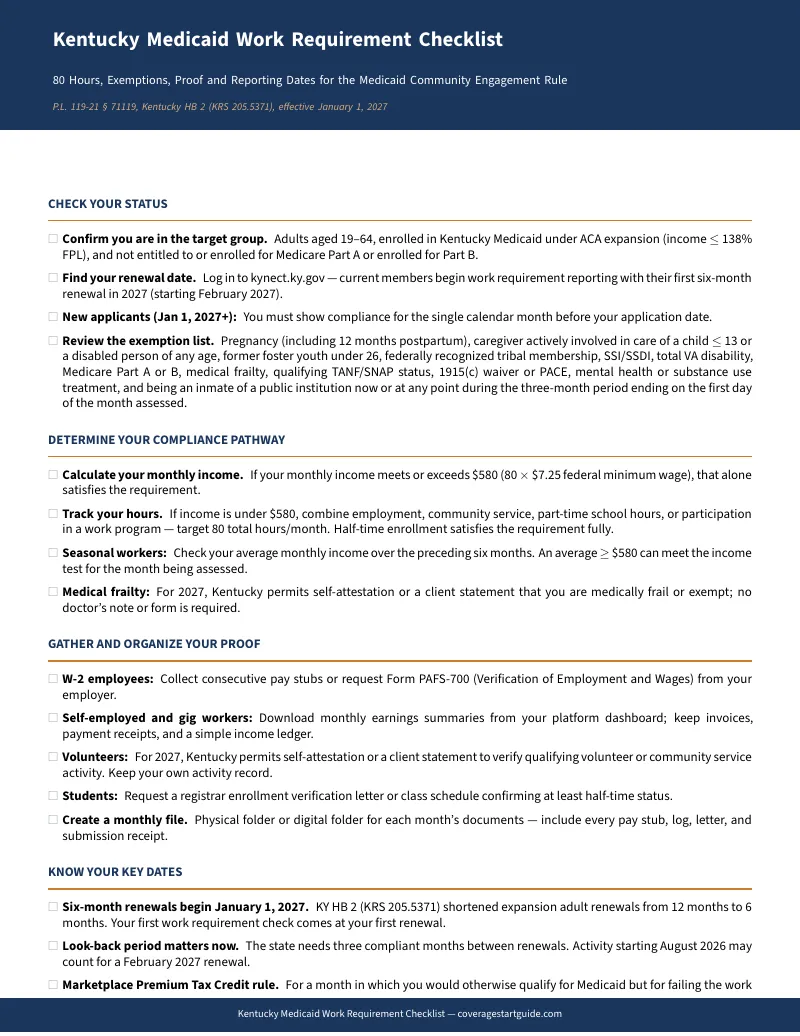
The free checklist covers the basics: the applicability questions, the core exemptions, the key dates and the free-help contacts. The full guide adds the how — chapter-by-chapter instructions, five real-scenario walkthroughs, six standalone worksheets you can print and bring to appointments, and the complete exemption proof requirements.
Get the Kentucky Medicaid Work Requirement Guide →
Frequently Asked Questions
What if the rules change after I buy?
We update the guide when the rules change. Email us any time, even years later, and we'll send you the current edition free.