You got the letter about the 80-hour rule. Now you need to know exactly what to do.
Starting January 1, 2027, non-exempt adults aged 19 to 64 on ARHOME must report 80 hours of qualifying activity every month — or show at least $580 in monthly income. DHS already began running automated electronic checks during the July 2026 soft launch. When those checks cannot confirm your compliance or exclusion or exception, you get a written notice with 30 calendar days from receipt to respond before your coverage is suspended; for the separate 10-day continued-benefits rule, a mailed notice is presumed received five days after its date unless you show otherwise.
Arkansas tried a version of this in 2018–2019. By December 2018, more than 18,000 beneficiaries had been disenrolled for failing to comply with the requirement. Assessments identified lack of beneficiary awareness, inadequate outreach, and administrative challenges such as portal access as barriers to compliance. The requirement under Public Law 119-21 is permanent this time, and the administrative burden has not gotten simpler.
The Arkansas ARHOME Compliance Binder System puts every rule, exemption, proof list, Access Arkansas portal step, and appeal deadline in one place, in plain language, so you can build a complete record before a DHS notice ever arrives.
What makes this different from free information
The rules are on the DHS website. Nobody is hiding them. But they are scattered across the ARHOME FAQ, the community engagement town hall slides, DCO county office communications, and dense federal regulatory language. DHS explains that automated electronic checks verify compliance, but not what to do when those checks miss your gig income or fail to register your exemption. The Access Arkansas portal lets you upload documents, but it does not tell you which documents your situation requires or how to verify that an upload actually went through.
This guide takes every piece of that — PL 119-21, the DHS implementation guidance, the Access Arkansas portal procedures, the Office of Appeals and Hearings process — and turns it into a step-by-step system you can follow on your own schedule, offline if you need to. It is the preparation you do before calling Access Arkansas at 1-855-372-1084 or visiting a DCO county office, so the conversation is quick and productive instead of a guessing game.
What's inside
- Applicability and Exemption Decision Worksheet — find out in two minutes whether the work requirement applies to you, based on your age, ARHOME enrollment status, and federal exclusions and exceptions, with examples of records to gather
- Monthly Activity Combination Ledger — a structured ledger for tracking combinations of paid employment, gig work, self-employment, unpaid work, structured community service, qualifying work-program participation, and education toward the 80-hour threshold
- Gig-Worker Income Calculation Sheet — step-by-step fields for platform hours and MAGI-based household income against the $580 alternative (the federal minimum wage of $7.25 × 80 hours); because Arkansas's state minimum wage is higher, fewer physical hours may be enough
- Federal exclusion and exception guide — caregiving; medical frailty; participation in a qualifying drug or alcohol treatment program; total VA disability; SNAP/TANF work rules; former foster youth; incarceration in a public institution during the prior three months; pregnancy and up to 12 months postpartum; tribal, Urban Indian, or applicable IHS status; and Medicare Part A or B, plus the optional federal short-term hardship exception and examples of records to organize
- Access Arkansas portal walkthrough — step-by-step instructions for logging hours, uploading proof documents, and verifying that your submissions registered — plus troubleshooting for upload failures and confirmation receipt gaps
- DHS Notice Action Log and Fair Hearing Preparation Checklist — what a 30-day noncompliance notice means, what happens during the response period, and federal rules requiring continued benefits when you request a hearing within 10 days after receipt and the agency determines the action did not result from applying federal or state law or policy; plus the Office of Appeals and Hearings mailing address at P.O. Box 1437, Slot S101, Little Rock, AR 72203-1437
- Five real-world scenarios — a retail worker with shifting hours, a gig driver tracking the $580 threshold, a caregiver documenting an exemption, a student combining education with part-time work, and an enrollee responding to a noncompliance notice — each one walked through from start to finish
- Free help directory — verified contact details for DHS Access Arkansas, the Update Arkansas Hotline, the Office of Appeals and Hearings, Legal Aid of Arkansas (1-800-952-9243), Healthy Connections certified assisters (1-888-710-8220), and Arkansas Advocates for Children and Families
Who this is for
- Adults on ARHOME who need to meet the 80-hour rule — whether you work a regular job, drive for a rideshare app, do seasonal agricultural work, or piece together multiple part-time and gig shifts that fluctuate above and below 80 hours each month
- Family members handling the paperwork — if you are helping a parent, adult child, or partner navigate the work requirement, the guide includes the authorized representative setup process and a file management system designed for someone managing another person's compliance
- People who think they might be exempt — the Applicability and Exemption Decision Worksheet tells you which of the 10 categories fits, what proof to gather, and how to report it so the exemption holds when DHS runs its automated checks. Being enrolled in a Medically Frail plan does not automatically exempt you — the guide explains the difference between that plan assignment and an actual exemption determination
- Anyone who already got a noncompliance notice — the DHS Notice Action Log and the Fair Hearing Preparation Checklist are designed for people on a deadline right now
Why not just call Access Arkansas?
You should call Access Arkansas — and the guide tells you exactly when and why. But call volumes are high, hold times are long, and rural Arkansas has some of the worst broadband gaps in the country. The guide is the preparation you do before that call or county office visit, so the conversation takes five minutes instead of five attempts.
Legal Aid of Arkansas and certified assisters through Healthy Connections are free resources the guide sends you to. But they serve hundreds of thousands of potential enrollees across the state and cannot sit with everyone for an hour to work through every exemption category, every document, and every deadline. The guide gives you that preparation — organized, offline, at your own pace.
Important: this is not a government guide
This guide is published by Coverage Start Guide, an independent publisher. It is not affiliated with the Arkansas Department of Human Services, DMS, DCO, CMS, HHS, or any ARHOME private health plan. It does not provide legal advice and it does not guarantee eligibility, exemptions, or hearing outcomes. DHS, Legal Aid of Arkansas, and certified navigators help for free — the guide lists every one of them and tells you when to call.
If your coverage is about to end in fewer than 10 days, skip this page and contact Legal Aid of Arkansas at 1-800-952-9243 or your local DCO county office. They help for free and they can act faster than any guide.
What you get
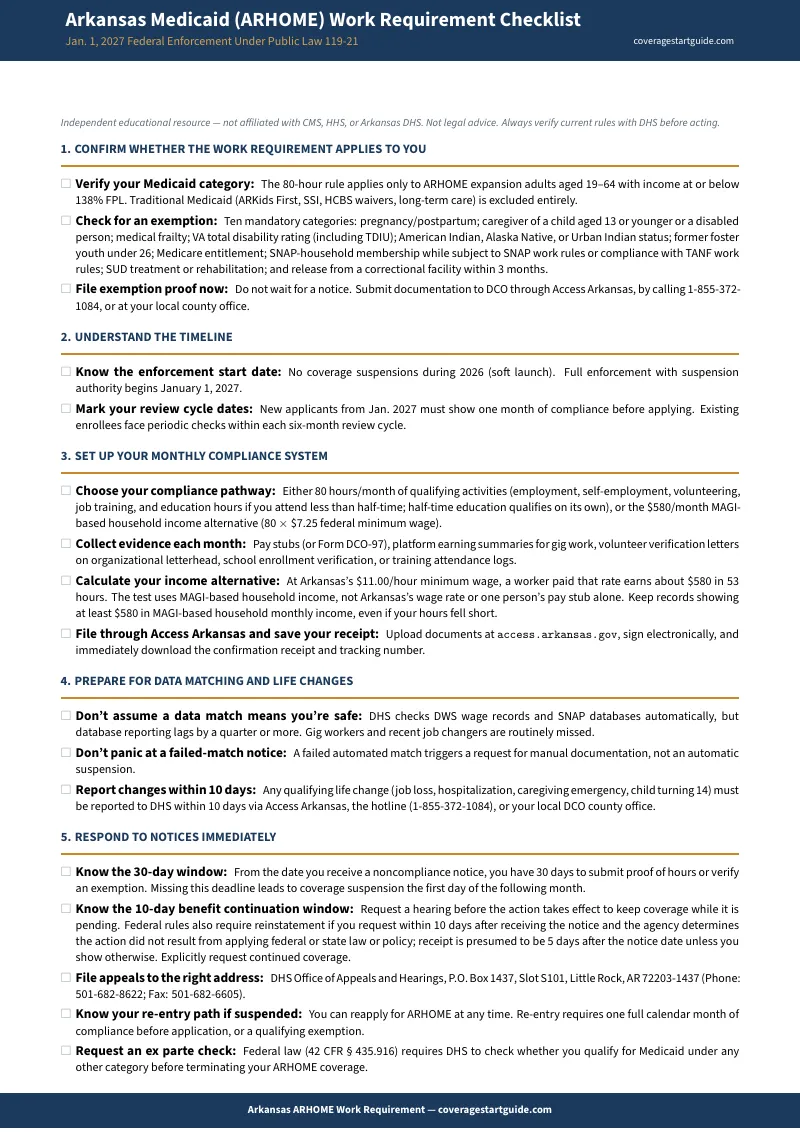
Your download includes the 41-page guide (PDF, readable on any device or printable), eight standalone printable worksheets — the Applicability and Exemption Decision Worksheet, Monthly Activity Combination Ledger, Gig-Worker Income Calculation Sheet, Volunteer and Education Documentation Tracker, DHS Notice Action Log, Fair Hearing Preparation Checklist, Agency Communication and Upload Log, and Authorized Representative Handoff Sheet — and a two-page quick-reference checklist. The guide is dated and reflects the current DHS implementation guidance under Public Law 119-21. Full refund, no time limit — email [email protected] and we will process it.
The free checklist covers the basics: the applicability questions, the main federal exclusions and exceptions, the key dates, and the free-help contacts. The full guide adds the how — chapter-by-chapter instructions, five scenario walkthroughs, standalone worksheets you can print and bring to appointments, and examples of records to gather for each category.
Get the Arkansas ARHOME Work Requirement Guide →
Frequently Asked Questions
What if the rules change after I buy?
We update the guide when the rules change. Email us any time, even years later, and we'll send you the current edition free.