You got the letter. Now what?
Virginia Medicaid is changing. Starting January 2027, some adults ages 19 to 64 enrolled in Medicaid Expansion (Cardinal Care) must meet 80 hours a month of work, volunteering, education, or training — unless they qualify for an exemption. Miss a deadline and your coverage can end at your next six-month renewal.
The state will mail you forms. Cover Virginia will give you a phone number. CommonHelp will give you a login screen. But none of them will walk you through the whole process from start to finish — figuring out whether the rule applies to you, what information your caseworker may use or request, and what to do (and how fast) when something goes wrong.
That's the gap this guide fills.
The Compliance Roadmap System
The Virginia Medicaid Work Requirement Guide is a step-by-step compliance roadmap built for the specific rules DMAS has published for 2027. It doesn't just list what the requirements are — it walks you through what to do about them, in the order you need to do it.
Inside, you'll find:
- An applicability walkthrough — answer a short set of questions to confirm whether the 80-hour rule applies to your situation, so you don't spend time reporting hours you don't owe
- The Exemption Documentation Checklist — every exclusion and exemption category (medical frailty, caregiver, pregnancy, and more), what evidence DMAS may use or request, and what they've said about documentation for 2027
- The Income-to-Hours Conversion Worksheet — how to turn 1099 platform earnings, variable shift work, and irregular income into countable MAGI, including the $580 monthly income shortcut that eliminates hour-by-hour tracking
- The reporting walkthrough — exactly how to report through CommonHelp, what information DMAS can already see from its own records, and the Agency Communication Log for every upload and call
- The Renewal Timeline Tracker — the 30-day appeal window, the five-day receipt presumption that usually makes it 35 days from mailing, the 10-day advance notice, and how to request continued coverage and file before coverage ends or within 10 days of the notice
- The Appeal Preparation Organizer — what happens at a hearing, the evidentiary case summary the state must provide at least 5 business days before the hearing, and what evidence strengthens your case
- A Virginia help directory — Cover Virginia, your local DSS, legal aid (VPLC, LAJC, CVLAS), and navigator programs, with what each one can and can't do for you
- Six printable worksheets — Monthly Activity Log, Exemption Documentation Checklist, Income-to-Hours Conversion Worksheet, Renewal Timeline Tracker, Appeal Preparation Organizer, and Agency Communication Log
Who it's for
This guide is for:
- Adults on Cardinal Care who received a letter about the work requirement and need to know what to do before their next renewal
- Family members helping a parent, sibling, or adult child navigate the new rules — especially if they're the one keeping track of paperwork and deadlines
- Gig workers and part-time employees whose hours or income vary month to month and who need to know how the state counts irregular work
- Anyone who got a notice saying their coverage will end for non-compliance and needs to act quickly
Why not just use what's free?
Free help exists and it's real. Cover Virginia answers questions on the phone. Legal aid organizations provide free representation at hearings. Navigators help with applications and renewals. The guide tells you how to reach all of them.
But here's what free resources don't cover: the full process, in order, with the deadlines and documentation requirements connected. DMAS publishes the rules across dozens of PDFs, toolkits, and FAQ pages. CommonHelp gives you a login screen but no instructions for what to upload or how to format it. Legal aid prioritizes complex cases and has capacity limits. Etsy trackers give you a blank spreadsheet with no Virginia legal context.
This guide takes every step you need — from "does this apply to me?" through "how do I prepare for a hearing?" — and puts them in one place, in the order you need them, with the specific deadlines and proof that apply in Virginia.
What you're not getting
This is not legal advice. It's not connected with DMAS, CMS, or any state agency or managed care plan. It can't guarantee eligibility, exemption approvals, or hearing outcomes. What it does is explain the process clearly so you can make informed decisions — and it points you to the free professional help available at every step.
Satisfaction guarantee
If the guide isn't what you expected, email [email protected] for a full refund, no time limit.
Start with the free checklist
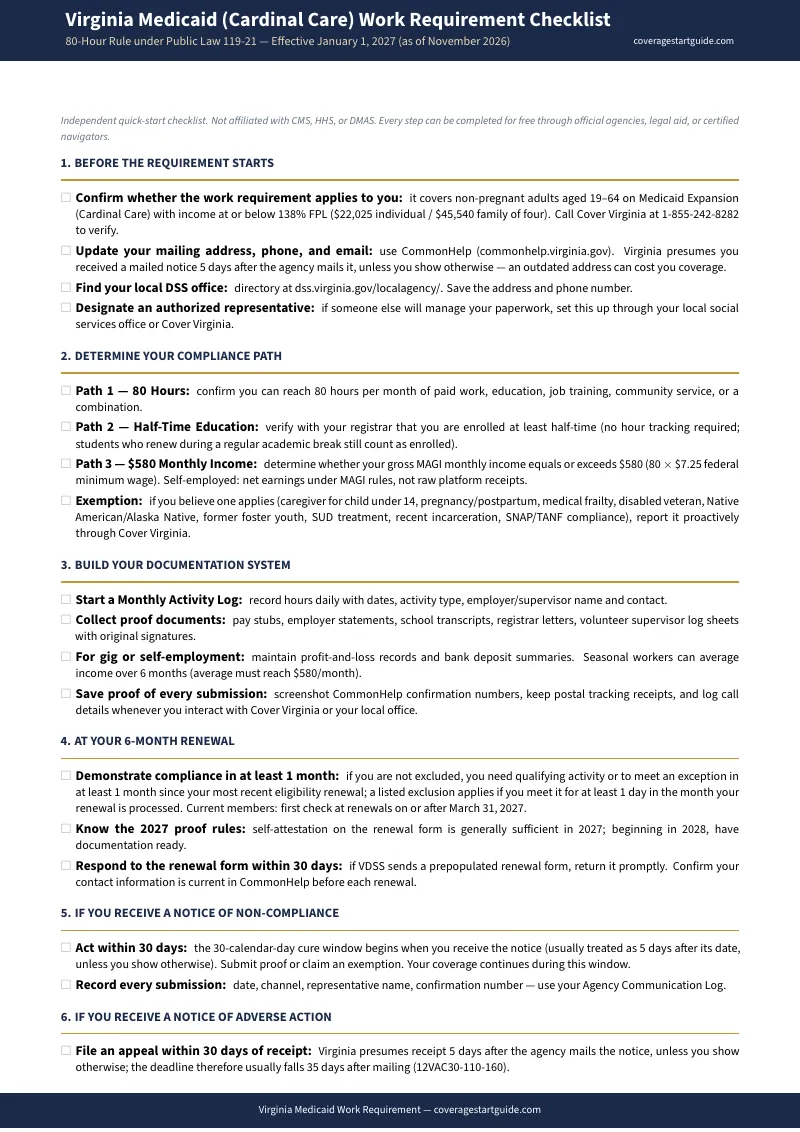
Not sure yet? Download the free Virginia Medicaid Work Requirement Checklist — a two-page summary of the key dates, exemptions, and reporting steps. If you need the full walkthrough, the complete guide is here when you're ready.
Frequently Asked Questions
Is this an official guide from DMAS or the Virginia Medicaid program?
No. This is an independent educational guide. It is not connected with DMAS, CMS, HHS, or any state agency or managed care plan. Free help from your state agency, legal aid, and navigators is real and valuable — and the guide tells you exactly how to reach each one.
When does the work requirement actually start?
The 80-hour requirement takes effect January 1, 2027 for new applicants. Current members are checked at their renewal — DMAS is phasing in checks for members with renewals scheduled March 31, 2027 or later. The guide explains the rollout timeline so you know when your deadline falls.
What if I already have an exemption?
The guide covers every exemption category — including DMAS's 2027 approach, where application or renewal information is enough in most cases and DMAS may ask for more information. Even if you believe you're exempt, the guide helps you confirm it and understand what to do if the state disagrees at renewal time.
Can this guide help if I already lost coverage?
Yes. The guide covers the appeal process, the 30-day appeal window (usually 35 days from mailing under the five-day receipt presumption), how to request continued coverage while your case is reviewed, and how to reapply if the appeal window has passed.
I'm helping a family member — is this guide still useful?
It's written for exactly that situation. Many buyers are family members organizing paperwork and tracking deadlines for someone else. The guide puts every step, deadline, and phone number in one place so you can help without guessing.
How is this different from the free checklist?
The free checklist gives you a two-page summary: exemptions, key dates, and the basic reporting steps. The full kit goes deeper on every topic — the Income-to-Hours Conversion Worksheet, the Exemption Documentation Checklist, the fair hearing process, and the Renewal Timeline Tracker for the deadlines that determine whether you keep coverage while your case is reviewed.
Frequently Asked Questions
What if the rules change after I buy?
We update the guide when the rules change. Email us any time, even years later, and we'll send you the current edition free.