Keep Your Ohio Medicaid Coverage — Without Losing It to Missing Paperwork or a 15-Day Deadline
An Independent Administrative Navigation Kit for Beneficiaries and Family Helpers
Independent Publisher Notice: Coverage Start Guide is an independent publisher. This guide is not affiliated with, endorsed by, or authorized by the Centers for Medicare & Medicaid Services (CMS), the U.S. Department of Health and Human Services (HHS), the Ohio Department of Medicaid (ODM), the Ohio Department of Job and Family Services (ODJFS), any county Job and Family Services (CDJFS) office, or any managed care plan. It is not legal advice and cannot guarantee eligibility, exemptions, or hearing outcomes. Essential steps can always be completed for free through your county JFS office, Ohio Legal Aid, and certified navigators.
The Problem Isn't Whether You Qualify — It's Proving It Before the Clock Runs Out
Under federal law (P.L. 119-21), Ohio's Group VIII expansion Medicaid adults aged 19 to 64 face an 80-hour monthly work and community engagement requirement — beginning January 1, 2027 for new applications and March 2027 for renewals — alongside a shift from annual renewals to six-month renewal cycles.
Most people who lose coverage under work rules aren't trying to avoid the requirement. They already work fluctuating shifts, drive for delivery apps, care for a child or ill relative, attend classes, or live with a chronic health condition that qualifies them for an exemption. They lose coverage because:
- Automated state checks miss real life: ODM screens payroll databases and 1,935 ICD-10 claims codes, but automated lookups routinely miss cash or 1099 income, unpaid family caregiving, or health conditions without recent billed claims.
- County JFS bottlenecks punish messy paperwork: Ohioans report waiting two to six-plus hours on county JFS phone lines only to be disconnected at closing time, or discovering that uploaded documents were never matched to their case file.
- Notice deadlines are unforgiving: A Notice of Non-Compliance gives 30 calendar days to cure a gap. If a termination notice follows, you have just 15 calendar days inside the prior notice period to request a State Hearing and keep coverage active under Aid Paid Pending — if you miss that window, Ohio still requires retroactive reinstatement when the state or local agency receives the late request within 10 calendar days after the effective date and you show good cause (OAC 5101:6-4-01(C)).
Introducing the Ohio Proof-First Renewal System
Ohio Medicaid Work Requirement: 80 Hours, Exemptions and Reporting replaces guesswork and scattered policy PDFs with one ordered administrative workflow: the Ohio Proof-First Renewal System. Instead of reacting after a county notice arrives, you follow three clear stages:
- Confirm your exact path before ODM checks your case: Verify whether you are in Group VIII or an excluded category, check all 12 statutory exemptions, or confirm whether you meet the $580 monthly income shortcut, 80-hour rule, half-time school rule, or six-month seasonal average.
- Build a verifiable paper trail every time you report: Organize pay stubs, gig ledgers, practitioner letters, or caregiver documentation in formats county caseworkers can read quickly — and log every Ohio Benefits upload, phone call, and drop-off so lost paperwork cannot silently end your case.
- Protect your 30-day cure and 15-day hearing rights: Follow exact step-by-step response checklists and all five official ODJFS Bureau of State Hearings filing channels if ODM sends a Notice of Non-Compliance or termination letter.
What's Inside the Complete 51-Page Guide
- Group VIII Coverage Map & 2027 Renewal Timeline — Because thousands of Ohioans on ABD, SSI, Medicare, or children's Medicaid are outside Group VIII entirely. Confirm in five minutes whether the rule applies to you and when your six-month renewal clock starts.
- The 80-Hour, $580 Income Shortcut & Seasonal Averaging Playbook — Because you don't need 80 logged hours if your monthly MAGI household income hits $580 ($7.25 × 80). Includes worked partial-hours math when income falls below $580, half-time education rules, and six-month seasonal averaging examples.
- All 12 Statutory Exemptions & Backup Proof Paths — Because an unverified exemption triggers a request for proof. Covers pregnancy and 12-month postpartum, caregiving for children 13 and under or disabled individuals, SNAP/TANF compliance, VA total disability (including TDIU), former foster youth under 26, tribal/IHS status, and re-entry within 3 months.
- Medical Frailty & Substance Use Treatment Documentation Guide — Because ODM has no standard clinician form when its 1,935-code automated claims check misses your condition. Learn what your doctor or authorized practitioner needs to put in writing so your documentation is clear on the first review.
- Uneven Shifts, Gig Work & Informal Caregiving Record Guides — Because rideshare drivers, 1099 contractors, retail shift workers, and unpaid family caregivers rarely have neat W-2 pay stubs. Shows how to pair platform statements, profit-and-loss logs, registrar letters, and signed caregiving or volunteer verification records.
- Ohio Benefits Portal, 10-Day Change Rule & Form ODM 06723 Helper Walkthrough — Because family helpers need to know when informal assistance is enough and when to file Form ODM 06723 to sign forms, speak with CDJFS, or receive duplicate notices.
- 30-Day Cure & 15-Day Aid Paid Pending State Hearing Playbook — Because requesting within the 15-day prior notice period keeps benefits active under Aid Paid Pending, while a late request received by the state or local agency within 10 calendar days after the effective date requires retroactive reinstatement if good cause is shown (OAC 5101:6-4-01(C)) — even though you have 90 days to appeal (OAC 5101:6-3-02). Includes exact filing steps for SHARE Portal, email, phone, fax, and mail, plus what P.L. 119-21 means for Marketplace Premium Tax Credits.
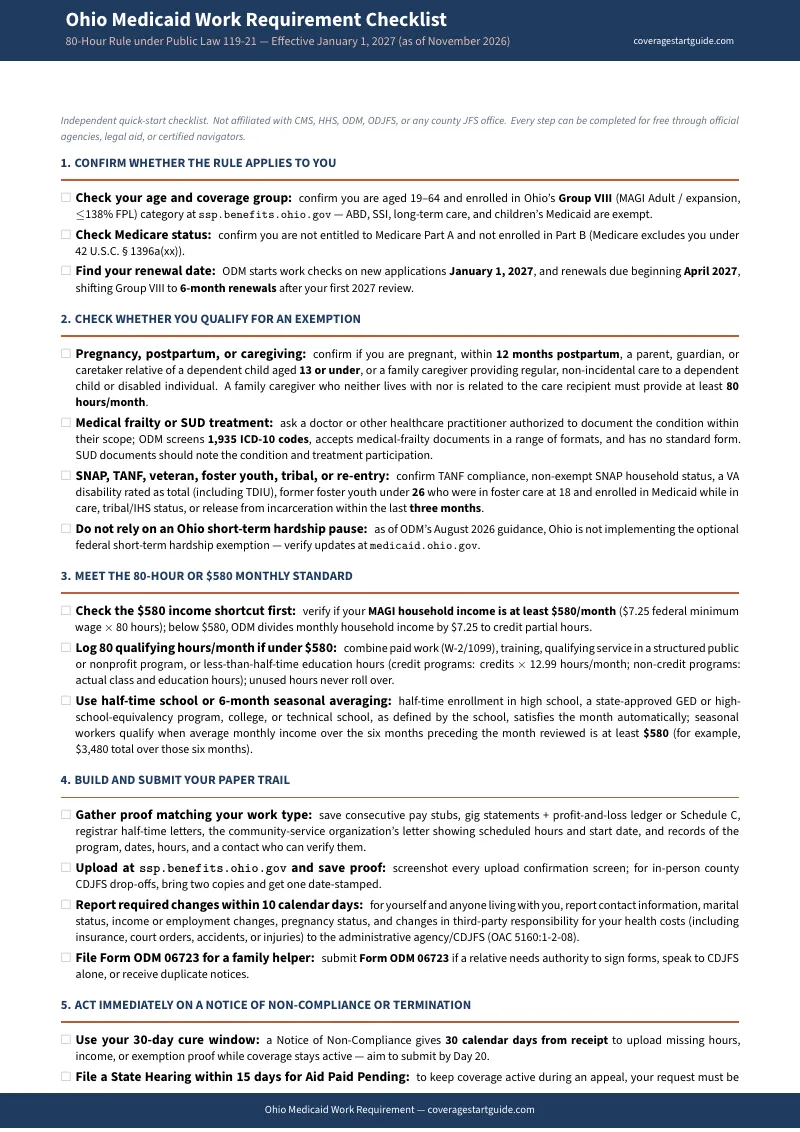
- Five Standalone Printable Planning Tools + Free Quick-Start Checklist (7 PDFs Total) — The Group VIII Applicability and Exemption Self-Check, Monthly Activity and Income Tracker, Self-Employment and Irregular Hours Calculation Log, Submission Receipt and Agency Communication Log, Notice-to-Hearing Deadline Calculator and Appeal Checklist, and the 2-page Ohio Medicaid Work Requirement Checklist.
Who This Guide Is For (And Who Should Use Free Help First)
This guide is built for:
- Ohio Group VIII Medicaid adults (ages 19–64) with fluctuating hourly schedules, gig or self-employment income, part-time classes, caregiving responsibilities, or medical conditions that automated state checks may miss.
- Family helpers and caregivers organizing renewals, uploads, Form ODM 06723 authorization, or hearing paperwork for a parent, spouse, or adult child.
Please use free public resources first if:
- Money is tight right now: Do not stretch your food, rent, or prescription budget for a guide. Grab our free two-page readiness checklist and use Ohio's free public help (county JFS, certified navigators at LocalHelp.HealthCare.gov, and Ohio Legal Help).
- You need legal representation at a hearing: Contact your regional Legal Aid Society or Disability Rights Ohio immediately — legal aid is free and this guide is not legal advice.
Why Not Rely Only on Free Agency Pages or Online Articles?
Official ODM and county JFS pages are free and remain the final authority on eligibility — we link directly to them throughout the guide. Where free resources fall short is day-to-day administrative organization:
- State agency pages explain policy, not personal record-keeping: ODM publishes rules and notices, but does not give you a monthly gig-income calculation log, an informal caregiver verification checklist, or a submission-receipt defense tracker.
- Managed care plans cannot decide eligibility: CareSource, Buckeye, Humana, and AmeriHealth Caritas send reminders and offer supportive benefits, but they cannot approve exemptions or overturn a county JFS termination.
- Legal Aid has strict capacity limits: Ohio's Legal Aid societies do vital work on active terminations and appeals, which leaves them little capacity for routine monthly hour-logging and pre-renewal organization.
- Generic national articles miss Ohio's specifics: Ad-supported blogs summarize federal headlines while skipping Ohio's Group VIII terminology, Form ODM 06723, Ohio's August 2026 position on short-term hardships, and OAC 5101:6-4-01 hearing timelines.
Dated Rules & Full Refund, No Time Limit
Every rule, citation, and contact in this guide is verified and dated as of November 2026 against official ODM publications, the Ohio Administrative Code, and P.L. 119-21, with direct links to check updates as 2027 approaches.
Full refund, no time limit: If this guide does not give you clear, practical organization for your Ohio Medicaid work requirement steps, email [email protected] anytime for a full refund — no hoops and no deadline.
Start Free or Get the Complete Toolkit
Not ready for the full guide? Download the free Ohio Medicaid Work Requirement Checklist on this page to check your Group VIII status, key exemptions, and free Ohio help numbers tonight.
Ready for the full 51-page guide, worked examples, and all five planning tools? Get instant download access — one-time purchase, backed by a full refund with no time limit.
Frequently Asked Questions
What if the rules change after I buy?
We update the guide when the rules change. Email us any time, even years later, and we'll send you the current edition free.