Keep Your NC Medicaid Coverage — Without Losing It to Missing Paperwork or a Missed Deadline
An Independent Administrative Navigation Guide for NC Health Works Enrollees and Family Helpers
Independent Publisher Notice: Coverage Start Guide is an independent publisher. This guide is not affiliated with, endorsed by, or authorized by the Centers for Medicare & Medicaid Services (CMS), the U.S. Department of Health and Human Services (HHS), the NC Department of Health and Human Services (NCDHHS), the Division of Health Benefits, any county Department of Social Services (DSS) office, or any Medicaid managed care plan. It is not legal advice and cannot guarantee eligibility, exemptions, or hearing outcomes. Essential steps can always be completed for free through your county DSS office, Legal Aid of North Carolina, and certified navigators.
The Problem Isn't Whether You Qualify — It's Proving It Before the Clock Runs Out
Under federal law (P.L. 119-21), North Carolina's expansion adults aged 19 to 64 on Medicaid (NC Health Works) face an 80-hour monthly work and community engagement requirement starting January 1, 2027, alongside a shift to six-month recertification cycles where NCDHHS checks compliance in at least 3 of the 6 months in each period.
Most people who lose coverage under work rules aren't trying to avoid the requirement. They already work fluctuating shifts, drive for delivery apps, care for a child or sick relative, attend classes, or live with a chronic health condition that qualifies them for an exemption. They lose coverage because:
- Automated state checks miss real life: Federal rules require states to first check reliable information already available to them, including income data sources when they provide hours worked. But current financial data sources cannot verify every type of work or show its hours, so some qualifying activities may need additional information from you.
- North Carolina's anti-self-attestation rule adds friction: Session Law 2026-1 (effective October 1, 2026) generally bars self-attestation as the only evidence for Medicaid eligibility verification. If the state cannot verify your compliance from available data, it may ask you for more information — and vague records slow the process.
- County DSS bottlenecks punish messy paperwork: NC enrollees report long hold times, unanswered voicemails, and ePASS portal errors that leave them unsure whether their documents were ever received or matched to their case file.
- Notice deadlines are unforgiving: A noncompliance notice starts a cure window. If a termination notice follows, current beneficiaries have 10 business days to request a fair hearing and ask for continued benefits; Medicaid may continue coverage while the appeal is reviewed.
Introducing the NC Proof-First Compliance System
NC Medicaid Work Requirement: 80 Hours, Exemptions and Reporting replaces guesswork and scattered policy PDFs with one ordered administrative workflow: the NC Proof-First Compliance System. Instead of reacting after a county notice arrives, you follow three clear stages:
- Confirm your exact path before NCDHHS checks your case: Verify whether you are in the expansion population or an excluded category, check every statutory exemption, or confirm whether you meet the $580 monthly income route, the 80-hour activity requirement, the half-time enrollment rule, or six-month seasonal averaging.
- Build a verifiable paper trail every time you report: Organize pay stubs, gig-income ledgers, practitioner letters, or caregiver documentation in formats county DSS caseworkers can read — and log every ePASS upload, phone call, fax, and in-person visit so lost paperwork cannot silently end your case.
- Protect your cure window and hearing rights: Follow exact step-by-step response checklists if NCDHHS sends a noncompliance notice or termination letter, and know the difference between the 10-business-day deadline for continued benefits and the broader fair hearing request window.
What's Inside the Complete 46-Page Guide
- NC Health Works Coverage Map & 2027 Timeline — Confirm in five minutes whether you are in the expansion population (ages 19–64, under 138% FPL) or an excluded category, and understand when your six-month recertification cycle begins and what "compliance in 3 of 6 months" means.
- The 80-Hour Standard, $580 Income Route & Seasonal Averaging Playbook — You don't need 80 logged hours if your MAGI-based household income reaches $580 per month. Covers partial-hour calculations when income falls short, half-time enrollment rules (as determined by the school), and six-month seasonal averaging for agricultural and hospitality workers.
- Every Statutory Exemption & Documentation Path — Step-by-step proof checklists for pregnancy and postpartum, caregiving for a dependent child or disabled individual, students enrolled at least half-time, medical frailty, former foster youth under 26, tribal and IHS eligibility, justice-involved transition periods, substance use disorder, participation in a drug or alcohol treatment program, and more — based on current NC guidance, with a note that the medical-frailty policy remains a draft as of November 2026.
- Gig Work, Self-Employment & Informal Caregiving Record Guides — Rideshare drivers, 1099 contractors, seasonal shift workers, and unpaid family caregivers rarely have neat W-2 pay stubs. See how to pair platform activity summaries, self-employment income ledgers, registrar letters, and caregiver verification records into organized submissions a caseworker can process on the first review.
- ePASS Reporting, County DSS Submission & Proof-of-Delivery Walkthrough — How the state checks available reliable data, how to upload documents through ePASS and what to do when the portal errors, submission channels for county DSS (in-person, fax, certified mail), and how to build a defensible delivery log with confirmation numbers and contact names.
- Authorized Representative (Form DHB-5202C-ia) Helper Guide — When a family helper assists with ePASS uploads, county DSS visits, or hearing paperwork, this chapter explains when informal help is enough and when to file the formal designation form.
- Noncompliance Cure & Fair Hearing Deadlines — How to respond inside the cure window, how to request a fair hearing within 10 business days of a termination notice and ask for continued benefits, and what P.L. 119-21 means for Marketplace Premium Tax Credits if coverage ends.
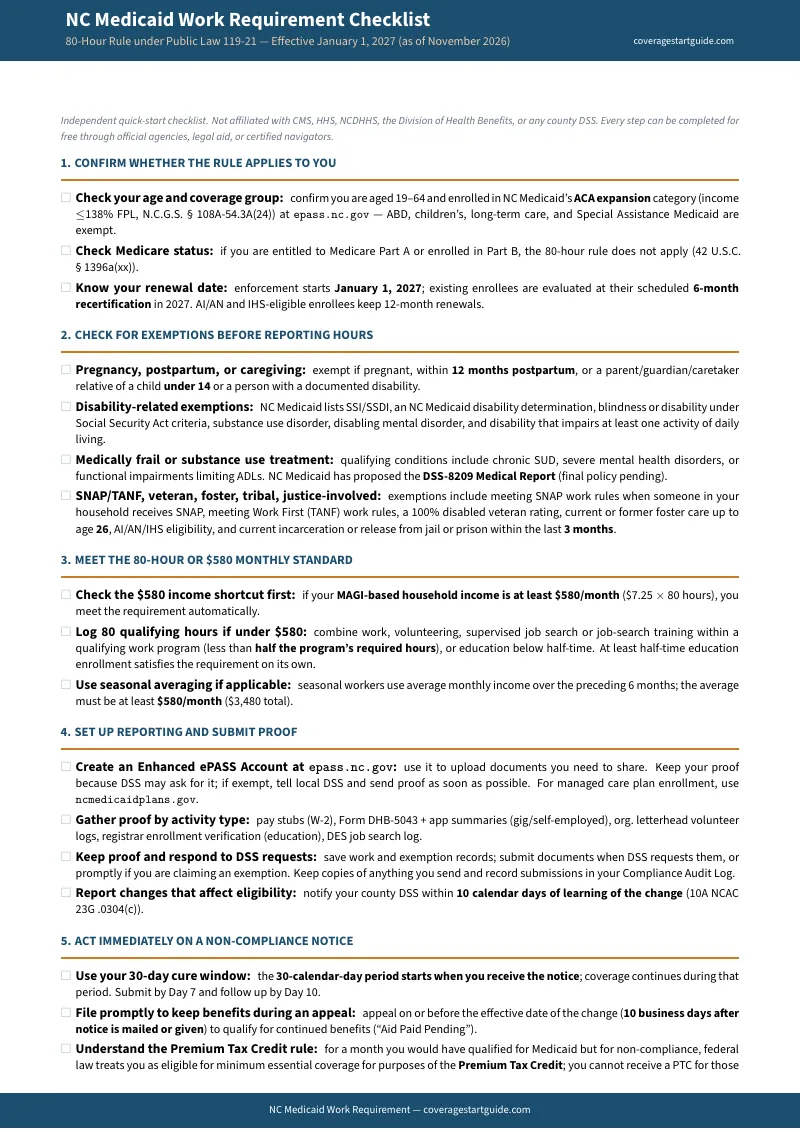
- Five Printable Planning Worksheets + Free Quick-Start Checklist — Your download includes five standalone printable PDFs: the Monthly Hours Tracker (record daily activities with running totals), Compliance Audit Log (track every ePASS upload, phone call, fax, and visit), Exemption Documentation Checklist (12 NC exemption categories with proof requirements and submission tracking), Hearing Preparation Worksheet (notice details, deadline calculator, evidence organizer, and response options), and Self-Employment Income Ledger (daily hours, gross receipts, expenses, and net income per platform). Plus the 2-page NC Medicaid Work Requirement Checklist.
Who This Guide Is For (And Who Should Use Free Help First)
This guide is built for:
- NC Health Works expansion adults (ages 19–64) with gig work, self-employment, fluctuating shift schedules, part-time classes, caregiving responsibilities, or medical conditions that automated state data checks may miss.
- Family helpers organizing ePASS uploads, county DSS submissions, authorized representative paperwork, or hearing deadlines for a parent, spouse, or adult child.
Please use free public resources first if:
- Money is tight right now: Do not stretch your food, rent, or prescription budget for a guide. Grab our free two-page readiness checklist and use North Carolina's free public help — your county DSS office, certified navigators through the NC Navigator Consortium, and Legal Aid of North Carolina.
- You need legal representation at a hearing: Contact Legal Aid of North Carolina or Pisgah Legal Services immediately — legal aid is free and this guide is not legal advice.
Why Not Rely Only on Free Agency Pages or Online Articles?
Official NCDHHS and county DSS pages are free and remain the final authority on eligibility — we link directly to them throughout the guide. Where free resources fall short is day-to-day administrative organization:
- State agency pages explain policy, not personal record-keeping: NCDHHS publishes rules and notices; this guide brings gig-income records, exemption evidence, and submission follow-up into one workflow.
- County DSS offices are overwhelmed: Enrollees report weeks-long hold times, unanswered voicemails, and ePASS portal errors — caseworkers cannot help you build a proof ledger for 80 hours of mixed activities.
- Managed care plans cannot decide eligibility: Your PHP (Healthy Blue, WellCare, AmeriHealth Caritas, Carolina Complete Health) sends reminders, but it cannot approve exemptions or overturn a county termination.
- Generic national articles miss NC's specifics: Ad-supported blogs summarize federal headlines while skipping NC's anti-self-attestation rule, the ePASS portal's quirks, Form DHB-5202C-ia for authorized representatives, and NC-specific fair hearing procedures.
Dated Rules & Full Refund, No Time Limit
This guide is dated November 2026 and links to official NCDHHS publications, North Carolina Session Laws, and P.L. 119-21 so you can check for updates as 2027 approaches.
Full refund, no time limit: If this guide does not give you clear, practical organization for your NC Medicaid work requirement steps, email [email protected] anytime for a full refund — no hoops and no deadline.
Start Free or Get the Complete Toolkit
Not ready for the full guide? Download the free NC Medicaid Work Requirement Checklist on this page to check whether the rule applies to you, see key exemptions, and find free help contacts tonight.
Ready for the full 46-page guide, five printable planning worksheets, and worked examples? Get instant download access — one-time purchase, backed by a full refund with no time limit.
Frequently Asked Questions
What if the rules change after I buy?
We update the guide when the rules change. Email us any time, even years later, and we'll send you the current edition free.