Keep Your Heritage Health Adult Coverage Without Getting Tripped Up by Notices, Portal Confusion, or Missed Deadlines
You work the hours, volunteer at the food bank, or care for your kids — and then a DHHS letter arrives with a 30-day deadline, an iServe upload fails because the file format is wrong, or a website still describes rules that changed months ago. When coverage is on the line, guessing at which form to file and which deadline matters is a gamble nobody should have to take.
For adults aged 19–64 on Heritage Health Adult Medicaid in Nebraska — and the family members helping them stay covered — the hardest part is rarely willingness to comply. It is piecing together scattered rules from DHHS web pages, Legal Aid fact sheets, and news articles while a 30-day clock is already ticking.
Introducing the Nebraska Compliance Binder
Nebraska Medicaid (Heritage Health Adult) Work Requirement: 80 Hours, Exemptions and Reporting is a 13-chapter plain-language workbook built around the Nebraska Compliance Binder: a simple, repeatable method for tracking qualifying hours as they happen, understanding which of the 12 state-recognized exemptions applies to you, and keeping every DHHS notice, iServe upload receipt, and mailed document in one audit-ready folder.
Instead of scrambling to reconstruct months of variable shifts or gig work when a 30-day notice arrives, you have the exact rules, worked examples, and printable tools ready before you ever open iserve.nebraska.gov or meet with a Legal Aid attorney, if you qualify for its free representation.
What's Inside the Complete Guide & Printable Toolkit
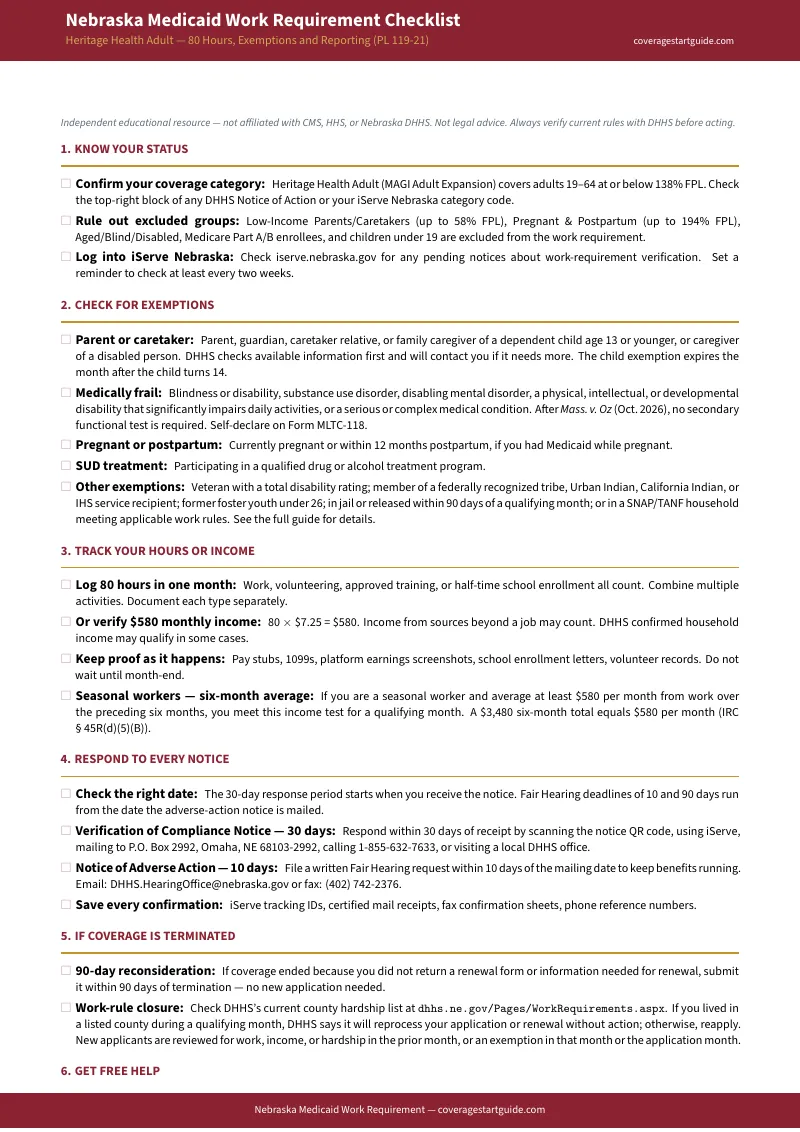
- Complete 13-Chapter Nebraska Guide (42-page PDF) — because state rules are split across DHHS policy pages, iServe portal screens, and fair hearing procedures with no single printable reference tying them together. Get clear answers on who must comply (adults 19–64 at or below 138% FPL — roughly $22,025 a year for one person), qualifying activities and how to combine them, the $580 qualifying-income alternative and the six-month seasonal-income average, all 12 exemptions, the notice cascade from non-compliance to coverage loss, and the Form DA-6 fair hearing process.
- Form MLTC-118 Field-by-Field Instructions — because the official 5-page Individual Declaration Form asks you to attest to activities and exemptions but does not explain which evidence DHHS actually wants for each one. Walk through every field on the May 2026 revision so nothing is left blank or misreported.
- Monthly Activity and Income Tracker — because combining part-time shifts, volunteer hours, and vocational training credits in a single month is where math mistakes happen. Log every qualifying activity in one monthly sheet and check both the 80-hour threshold and the $580 income alternative without double-counting overlapping hours.
- Self-Employment and Gig Hours Worksheet — because 1099 contractors, rideshare drivers, and seasonal workers do not get W-2 paystubs and often waste hours assembling records DHHS never asked for. Record weekly hours by client or activity type, then use the log to organize the primary-source documents DHHS requests.
- Exemption Proof Organizer — because knowing you qualify for caregiver status, medical frailty, or another exemption does not help if you submit the wrong documentation. Track your category, the required proof (or confirm that DHHS already has the data it needs from its own records), and the status of your declaration in one place.
- Submission Receipt Log — because iServe uploads do not automatically issue structured confirmation receipts, and phone calls to the DHHS call center drop after hours of holding. Track every iServe confirmation number, certified mail tracking number, email to [email protected], and DHHS representative name so nothing disappears without a paper trail.
- DHHS Notice Decoder and Deadline Calculator — because missing the difference between the 30-day information request window, the 90-day fair hearing deadline, and the 10-day window that keeps benefits running during your appeal can cost you coverage before your case is even heard.
- Form DA-6 Fair Hearing Preparation Packet — because walking into a DHHS Hearing Office appeal unprepared makes it nearly impossible to present your case clearly. Organize your written hearing petition, evidence binder, and argument notes step by step.
Who This Guide Is For
- Heritage Health Adult enrollees (ages 19–64) juggling variable hourly schedules, gig or self-employment work, vocational training, or volunteering — and people caring for children or someone with a disability who need to check whether an exemption applies.
- Adult children, spouses, and family helpers who want one clear, printable system to organize a loved one's documents, verify deadlines, or prepare for a call to the DHHS eligibility line.
- Anyone preparing for a Legal Aid meeting, if eligible, or a navigator meeting who wants to hand an attorney or Certified Application Counselor a complete, chronological file on day one.
Why Free Online Articles and Generic Trackers Fall Short
The underlying rules are public, and official state help is always free — but free information online leaves three gaps that trip up Nebraska enrollees:
- Official pages explain rules in pieces, not in order: DHHS policy pages, iServe portal instructions, Form MLTC-118, and fair hearing rules live on separate websites with no printable worksheets connecting them.
- Third-party articles are often out of date or national: Many pages still describe proposed federal rules or other states' programs without reflecting Nebraska's May 1, 2026 implementation date, the specific exemption categories DHHS recognizes, or the forms Nebraska actually uses.
- Generic 80-hour trackers miss Nebraska-specific rules: General printable logs do not cover iServe upload procedures, the fact that DHHS checks its own records before asking you for proof (ex parte verification), the $580 income alternative, or how to request continued benefits within 10 days of an adverse notice in Nebraska.
Free Official Help & Important Boundaries
You do not need to pay anyone to report hours, claim an exemption, or request a fair hearing. If you are facing an immediate coverage loss or money is tight, contact these free official and nonprofit resources first:
- DHHS Customer Service Center: 1-855-632-7633 ·
dhhs.ne.gov· Mail: P.O. Box 2992, Omaha, NE 68103-2992 - iServe Nebraska Portal:
iserve.nebraska.gov(submissions, uploads, Form MLTC-118 declarations) - Legal Aid of Nebraska:
legalaidofnebraska.org(free legal representation for qualifying low-income individuals) - Charles Drew Health Center (Omaha): 402-451-3553 (Certified Application Counselors — free help with exemptions and document uploads)
Coverage Start Guide is an independent publisher — not affiliated with, endorsed by, or connected to CMS, HHS, the Nebraska Department of Health and Human Services, or any Heritage Health managed care plan. This guide is plain-language process navigation, not legal advice, and cannot guarantee eligibility, exemptions, or fair-hearing outcomes. Truthful reporting only: never overstate hours or claim an exemption you do not have.
Full Refund, No Time Limit
This guide is optional, and your purchase is completely risk-free. If it does not help you organize your Nebraska Medicaid paperwork, email [email protected] for a full refund, no time limit — no hoops and no questions asked.
Frequently Asked Questions
What if the rules change after I buy?
We update the guide when the rules change. Email us any time, even years later, and we'll send you the current edition free.