You got the letter. Now what?
Indiana's Healthy Indiana Plan work requirement starts January 1, 2027. If you're on HIP, age 19 to 64, not pregnant, and not enrolled in or eligible for Medicare, you'll need to meet the monthly requirement through 80 hours of qualifying activity, at least half-time education, or the $580 income alternative — unless an exemption applies. Miss the reporting window, and you could lose your coverage.
The state's website tells you the rule exists. It doesn't tell you how to organize your pay stubs, track your volunteer hours, or figure out whether your gig income clears the $580 threshold. It doesn't walk you through what happens after a noncompliance notice arrives — or how to request a hearing and have DFR receive your appeal by close of business (4:30 PM local time) on the day before the action's effective date to keep your coverage while it's decided.
That's what this guide does.
The HIP Compliance Organizer
This isn't a summary of the rules you can already find on FSSA's website. The HIP Compliance Organizer is a structured system for tracking, proving, and reporting your 80 hours — built around the specific problems Indiana HIP members actually face.
Gig workers with four different income sources. Caregivers who don't have a formal employer. People who got a letter they can't quite parse. Family members trying to keep a relative's coverage from lapsing because a form didn't get filed.
The guide puts every step in order — from figuring out whether you're subject to the requirement, through reporting your hours, all the way to requesting a fair hearing if something goes wrong.
What's Inside
- The 80-hour rule explained in plain language — what counts as a qualifying activity (employment, job training, education at least half-time, apprenticeships, work programs, community service, and volunteering), how FSSA defines each one, and the $580 monthly income alternative that lets your earnings speak for themselves
- Published exemption categories and current documentation guidance — medical frailty, pregnancy, caregiving for a child aged 13 or younger, SNAP or TANF work compliance, and more. FSSA says medical-frailty requirements are still being developed
- The lookback period decoded — new applicants use the three months before applying; existing members must show compliance in any three months since their last redetermination
- Five reporting channels — the FSSA Benefits Portal, phone, mail, fax, and in-person at your county DFR office. Step-by-step for each one, so you can use whichever works for your situation
- The noncompliance timeline — the 30-day period to submit proof after a notice, what happens if you don't respond, and the sequence of events from notice to coverage loss
- The fair hearing process — the 33-day deadline to request a hearing through DFR, the earlier deadline for keeping coverage while the appeal is pending, what evidence to bring, and how to prepare if you're representing yourself
- Printable tracking tools — a monthly activity tracking log, a self-employment earnings ledger with seasonal averaging, an exemption documentation checklist, an agency communication log, and a notice response timeline tracker you can fill in and bring to a navigator appointment or upload through the portal
Who This Is For
- HIP members aged 19 to 64 who have received a work requirement letter or expect to at their next redetermination
- Family members helping a parent, spouse, or adult child navigate the reporting process
- Gig workers and people with irregular hours who need to convert variable income into the state's 80-hour format
- People who may be exempt and need to organize their records using current FSSA guidance
- Anyone facing a noncompliance notice who wants to understand the hearing process and their rights
Why Not Just Use the Free State Resources?
You should use them — and the guide tells you exactly how to reach them. The FSSA Benefits Portal at fssabenefits.in.gov, the DFR call center at 1-800-403-0864, Covering Kids & Families of Indiana at 1-888-975-4CKF, and Indiana Legal Services are all free and all listed in the guide with their contact information.
What those resources don't do is organize your records for you. DFR processes your submissions — they don't track your gig hours across four apps or sort your volunteer letters by month. Navigators help you fill out forms — but they need you to show up with your documentation ready. Legal aid can represent you at a hearing — but they can't build your evidence binder from scratch in the waiting room.
The guide is the preparation layer. It gets your records organized before you use any of those free services — so when you do, you get the most out of them.
Satisfaction Guarantee
Full refund, no time limit. If the guide doesn't help you, email [email protected] and we'll send your money back. No forms, no questions.
Important Disclaimer
This guide is published independently by Coverage Start Guide. It is not connected with FSSA, DFR, CMS, HHS, the State of Indiana, or any managed care plan. It is not legal advice. It cannot guarantee eligibility, exemptions, or hearing outcomes. The guide explains the process, helps you organize your records, and always points you to the state agency, legal aid, and navigators as free help.
Start Organizing Your HIP Compliance
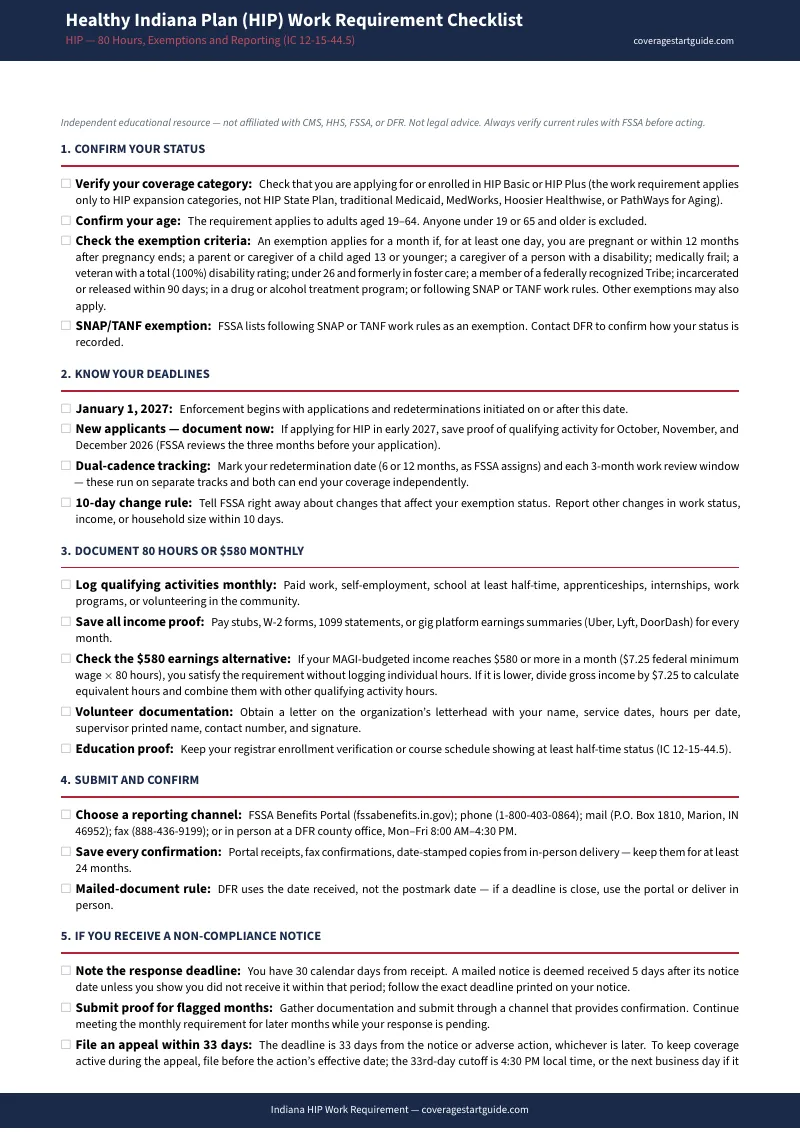
The free checklist gives you the essential steps — who the rule applies to, the main exemptions, the 80-hour threshold, and the key resources. The full HIP Compliance Organizer goes deeper: chapter-by-chapter explanations, printable tracking logs, the noncompliance and fair hearing timelines, and FSSA's published exemption categories with current documentation guidance. FSSA says medical-frailty requirements are still being developed. The price is — a one-time purchase with a full refund, no time limit.
Frequently Asked Questions
What if the rules change after I buy?
We update the guide when the rules change. Email us any time, even years later, and we'll send you the current edition free.