Keep Your Georgia Pathways Coverage Without Getting Tripped Up by Paperwork, Portal Errors, or Changing Rules
You work the hours, take the classes, or care for a young child — and then a DFCS letter arrives, a Georgia Gateway upload fails because your phone screenshot is a PNG, or a blog post tells you a rule that expired in 2025. When coverage is on the line, guessing between 2026 Georgia waiver rules and 2027 federal rules is a gamble nobody should have to take.
For adults aged 19–64 on Georgia Pathways — and the family members helping them stay covered — the hardest part is rarely willingness to comply. It is piecing together scattered rules from DCH, DFCS, Pathways FAQs, and OSAH while a 10-day or 30-day clock is already ticking.
Introducing the Georgia Compliance File System
Georgia Pathways Work Requirement: 80 Hours, Exemptions and Reporting is a 12-chapter plain-language workbook built around the Georgia Compliance File System: a simple, repeatable method for tracking qualifying hours as they happen, separating 2026 waiver rules from January 1, 2027 federal changes, and keeping every DFCS letter and Gateway upload receipt in one audit-ready folder.
Instead of scrambling to reconstruct months of variable shifts or gig work when an annual renewal packet shows up, you have the exact rules, worked examples, and six printable tools ready before you ever open gateway.ga.gov or sit down with a free legal aid attorney.
What's Inside the Complete Guide & Printable Toolkit
- Complete 12-Chapter Georgia Pathways Guide (47-page PDF) — because state rules are split across four agencies and two different policy years. Get clear answers on who must comply (adults 19–64 up to 100% FPL — $1,330/month for one person in 2026 with the 5% MAGI disregard) vs. excluded traditional Medicaid groups, exact college credit-hour conversions, the 10-day change-reporting duty, and the 90-day renewal reconsideration rule.
- 2026 Waiver vs. 2027 Federal Rule Matrix — because outdated articles still mix up both sets of rules. See side by side what applies through December 31, 2026 (no $580 income option, child under 6 as a qualifying activity, disability reasonable modifications, 120-hour annual Good Cause cap) and what changes starting January 1, 2027 under Public Law 119-21 ($580/month earnings alternative with 6-month seasonal averaging, full exemptions for parents of children 13 and under, medically frail adults, and active substance use disorder treatment).
- Monthly Activity and Income Tracker — because combining part-time shifts, college credits, and community service is where math mistakes happen. Log every qualifying track in one monthly sheet and check both the 80-hour threshold and the 2027 $580 MAGI alternative without double-counting overlapping hours.
- Self-Employment and Gig Hours Worksheet — because 1099 and gig workers don't get W-2 paystubs and often waste hours assembling mileage or invoice logs Georgia doesn't ask for. Record weekly hours by client or activity in the exact format Georgia's official Pathways guidance accepts.
- Exemption and Good Cause Proof Organizer — because knowing you qualify for relief does not help if you submit the wrong documentation. Track your category, required clinician or agency proof, and your running 120-hour annual Good Cause tally in one place.
- DFCS Notice Decoder and Deadline Calculator — because missing the difference between the 10-day Aid Paid Pending window (with mail-delivery allowances) and the 30-day fair hearing deadline can cut off coverage before your appeal is even heard.
- Agency Communication and Gateway Upload Log — because phone calls drop and portal uploads fail silently. Track every PDF/JPG/TIFF/BMP/DOCX file name, upload date, confirmation note, and DFCS worker name so nothing disappears without a paper trail.
- OSAH Fair Hearing Preparation Packet — because walking into an Office of State Administrative Hearings appeal unprepared is overwhelming. Organize your written hearing request, case-file requests, exhibit list, and hearing notes step by step.
Who This Guide Is For
- Georgia Pathways enrollees and applicants (ages 19–64) juggling variable hourly schedules, gig or self-employment work, college or technical-college credits, or caregiving.
- Adult children, spouses, and family helpers who want one clear, printable system to organize a loved one's documents, verify deadlines, or act as an authorized representative.
- Anyone preparing for a free legal aid or navigator meeting who wants to hand an attorney or Certified Application Counselor a complete, chronological file on day one.
Why Free Online Articles and Generic Trackers Fall Short
The underlying rules are public, and official state help is always free — but free information online leaves three gaps that trip up Georgia enrollees every week:
- Official pages explain rules in pieces, not in order: DCH policy pages, DFCS manuals, Georgia Gateway upload screens, and OSAH hearing rules live on separate websites with no printable worksheets connecting them.
- Third-party blogs are dangerously out of date: Many articles still claim monthly reporting is required (Georgia shifted routine reporting to initial application and annual renewal on October 1, 2025) or confuse the 2026 child-under-6 activity rule with the 2027 child-under-13 exemption.
- Generic 80-hour trackers miss Georgia-specific rules: General printable logs don't cover Georgia Gateway's accepted file formats, technical-college credit-hour cutoffs, the fact that CareSource, Peach State Health Plan, and Amerigroup cannot approve eligibility or waive hours, or how to elect Aid Paid Pending in Georgia.
Free Official Help & Important Boundaries
You do not need to pay anyone to apply for Georgia Pathways, report hours, or request a fair hearing. If you are facing an immediate coverage loss or money is tight, contact these free official and nonprofit resources first:
- DFCS Customer Contact Center: 1-877-423-4746 (8 a.m.–5 p.m.) ·
gateway.ga.gov· Pathways general inquiries: 404-656-4507 - Georgia Legal Services Program (154 counties outside metro Atlanta): 1-833-457-7529 (
glsp.org) - Atlanta Legal Aid Society (Fulton, DeKalb, Cobb, Gwinnett, Clayton): 404-524-5811 (
atlantalegalaid.org) - Georgia Access Contact Center (consumer support): 1-888-687-1503 (
georgiaaccess.gov)
Coverage Start Guide is an independent publisher — not affiliated with, endorsed by, or connected to CMS, HHS, Georgia DCH, or DFCS. This guide is plain-language process navigation, not legal advice, and cannot guarantee eligibility, exemptions, or fair-hearing outcomes. Truthful reporting only: never overstate hours or claim an exemption you do not have.
Full Refund, No Time Limit
This guide is optional, and your purchase is completely risk-free. If it does not help you organize your Georgia Pathways paperwork, email [email protected] for a full refund, no time limit — no hoops and no questions asked.
Start Tonight — Free Checklist or Complete Toolkit
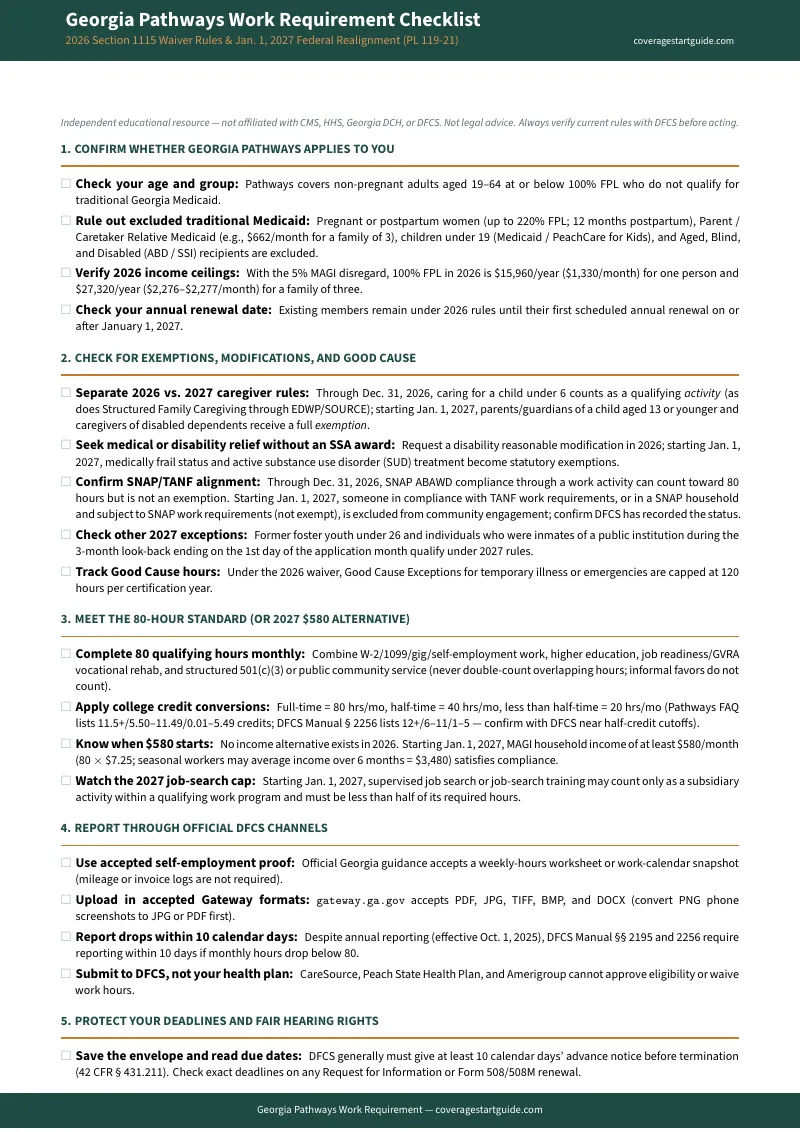
Need a quick overview first? Grab the free two-page Georgia Pathways Work Requirement Checklist above to check your 2026 vs. 2027 rules and keep every agency and legal aid number in one place.
Ready for the complete 12-chapter guide, worked examples, and all six printable tools in one instant download? Get the full toolkit right now and put the Georgia Compliance File System to work before your next deadline.
Frequently Asked Questions
What if the rules change after I buy?
We update the guide when the rules change. Email us any time, even years later, and we'll send you the current edition free.