Keep Your Arizona AHCCCS Coverage Organized — Without Guessing Which Rules Actually Apply
You open an envelope from DES or hear that Arizona Medicaid now requires 80 hours a month. You search online and run straight into a wall of contradictions: old articles citing the revoked 2019 "AHCCCS Works" waiver (which stopped at age 49 and had a two-month suspension), generic national summaries that never mention Health-e-Arizona Plus, and DES phone queues that can take days to get through while you are trying to work or care for family.
Meanwhile, the stakes are immediate. Losing AHCCCS over a missed deadline, a missing gig-income calculation, or an unlogged document upload does not just mean a surprise denial at the pharmacy counter — under federal H.R. 1 rules, disenrollment for work-requirement non-compliance also triggers a federal bar on HealthCare.gov premium tax credits.
Arizona AHCCCS Work Requirement: 80 Hours, Exemptions and Reporting is a 58-page, plain-language Arizona navigation guide built around the Arizona Dual-Clock & Paper-Trail System. It separates the live federal H.R. 1 mandate (Public Law 119-21, verified November 2026) from obsolete 2019 waiver noise, maps every exemption and income path in Arizona, and gives you five printable logs so every deadline and HEAplus upload is documented before a notice ever catches you off guard.
Independent private publication. Coverage Start Guide is not affiliated with, endorsed by, or connected to AHCCCS, the Arizona Department of Economic Security (DES), Health-e-Arizona Plus, CMS, HHS, or any government agency. This guide is educational process information, not legal advice, and cannot guarantee eligibility, exemptions, or hearing outcomes.
What's Inside the 58-Page Arizona Guide
- Applicability & Category Filter (Chapters 1–2) — Because many adults with chronic conditions are enrolled in Prop 204 or Adult Expansion rather than ALTCS or SSI-MAO, and checking your exact AHCCCS group first stops you from either missing a required report or wasting hours on a rule that does not apply to you.
- The 80-Hour Activity Playbook (Chapter 3) — Because standalone job search does not count under CMS-2454-IFC, and your school — not a universal 6-credit rule — defines half-time enrollment; this chapter shows exactly what counts and how to combine work, community service, qualifying work programs, and less-than-half-time classes.
- The $580 Monthly Income & Seasonal Averaging Workbook (Chapter 4) — Because fluctuating retail shifts, Uber/DoorDash 1099 earnings, and seasonal jobs trip up standard forms; includes worked examples for gross vs. net self-employment income, MAGI household income, and Arizona's 12-month and 6-month ($3,480 total) seasonal averaging checks.
- Mandatory Exemptions & Short-Term Hardships Map (Chapters 5–6) — Because knowing you qualify is only half the battle when DES asks for proof; covers caregivers of children aged 13 or younger or disabled family members, medical frailty, serious mental illness (SMI), substance use disorder treatment, tribal members, former foster youth under 26, recent incarceration, and all four federal short-term hardships, plus the October 2026 federal court stay and ADA/Section 504 accommodations.
- Ex Parte Checks, Six-Month Renewals & HEAplus Paper Trail (Chapters 7–8) — Because AHCCCS instructs members not to submit work proof until asked (as of November 2026), yet misrouted faxes and unlogged uploads still cost people coverage; walks through automatic electronic checks, six-month renewals (and why American Indians and Alaska Natives stay on 12-month renewals), HEAplus online uploads, and using your letter's QR fax cover sheet.
- The Dual-Clock Notice Decoder & Fair Hearing Prep (Chapters 9–10) — Because confusing the initial 35-day information request with the 30-day non-compliance opportunity period, the 90-day reconsideration period for MAGI members disenrolled for not returning information requested in a non-compliance notice, or Arizona's 35-day fair hearing deadline can end your benefits; maps every clock on one timeline and explains Aid Paid Pending and 7-working-day expedited hearings.
- Five Standalone Printable Compliance Worksheets (Chapter 11) — Monthly Activity and Income Tracker, Exemption and Hardship Proof Checklist, HEAplus Submission and Receipt Log, Agency Communication Log, and Fair Hearing Evidence Organizer — separate 2-page PDFs ready to print or hand directly to a navigator or legal aid attorney.
- Verified Arizona Free Help Directory (Chapter 12) — Direct contacts for AHCCCS (
KeepMyAHCCCS.com,855-220-0903), HEAplus (1-855-432-7587), Cover Arizona navigators, Community Legal Services, Southern Arizona Legal Aid, DNA People's Legal Services, andAZLawHelp.org.
Who This Guide Is For (and Who Should Skip It)
This guide is built for:
- Arizona adults aged 19–64 on AHCCCS expansion coverage (Prop 204 or Adult Expansion) with uneven shift hours, gig/1099 income, seasonal work, part-time classes, caregiving responsibilities, or medical conditions.
- Spouses, adult children, and family helpers who are compiling records, checking HEAplus notices, or preparing a clean file for a relative.
Please skip this guide if:
- You are enrolled in ALTCS, SSI-MAO, KidsCare, Medicare, or pregnancy/12-month postpartum coverage — the adult expansion work requirement does not apply to you.
- You face a coverage termination deadline within 48 hours and need direct legal representation right now — contact Community Legal Services, Southern Arizona Legal Aid, DNA People's Legal Services, or DES FAA immediately for free.
- Spending money on a guide would strain what you need for food, rent, or medication — use the free resources below instead.
Why Free Help Comes First — and Where This Guide Fits
Official information and direct help in Arizona are free, and you should use them whenever they fit your needs:
- AHCCCS & DES FAA: Official policy updates at KeepMyAHCCCS.com (H.R. 1 line:
855-220-0903) and case uploads at Health-e-Arizona Plus (healthearizonaplus.gov,1-855-432-7587). - Free Navigators & Legal Aid: Cover Arizona (
coveraz.org) provides free application and renewal help; Community Legal Services (clsaz.org), Southern Arizona Legal Aid (sazlegalaid.org), and DNA People's Legal Services provide free legal help for eligible residents.
Where people still get stuck is in the day-to-day gap between those services: agency webpages explain one rule per page without gig-income or seasonal-averaging worksheets, legal aid offices have intake capacity caps, navigators cannot represent you in a fair hearing, and private elder-law attorneys ($2,500–$7,500 retainers) focus on ALTCS long-term care rather than expansion work compliance. This guide gives you one calm, dated Arizona workbook and five printable logs so you stay organized on your own — or walk into a free legal aid appointment with a clean, date-stamped file.
Full Refund, No Time Limit
If you download the guide and discover you are automatically exempt, that free legal aid handles everything for you, or that it simply is not useful for your situation, email [email protected] for a full refund, no time limit. No hoops, no countdown, and no awkward questions.
Start Free or Get the Complete Arizona Guide
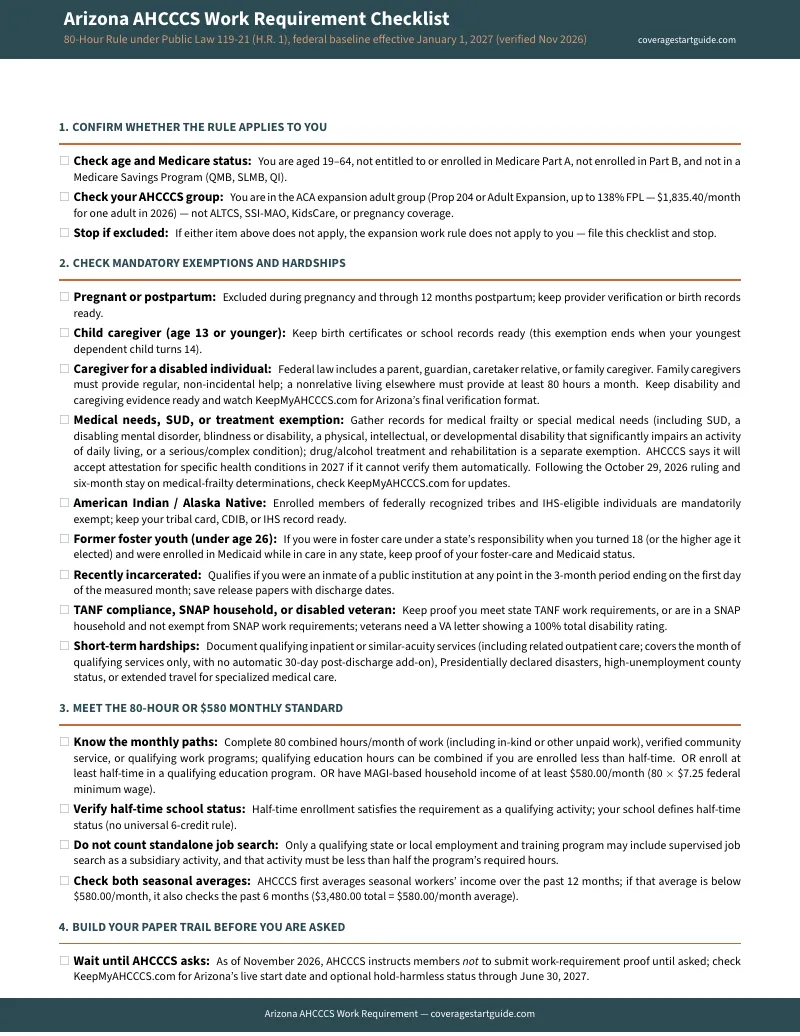
Not sure if you need the full workbook? Download the free two-page Arizona AHCCCS Work Requirement Checklist first — it includes the 24 core checkpoints, key deadlines, and all free Arizona contacts. Ready for the complete 58-page guide, worked income calculations, and five printable compliance worksheets? Choose the full guide above for instant PDF download.
Frequently Asked Questions
What if the rules change after I buy?
We update the guide when the rules change. Email us any time, even years later, and we'll send you the current edition free.